

 |
R
ecent research suggests that a layer of diamonds up to 18 kilometers (11 miles) thick might be buried beneath the surface of Mercury, the smallest and closest planet to the sun. This finding stems from experiments designed to replicate the extreme conditions present during Mercury's early formation.
Scientists believe these diamonds could have formed shortly after Mercury coalesced from a primordial cloud of dust and gas about 4.5 billion years ago. During this period, the planet is thought to have had a graphite crust floating above a deep magma ocean. Researchers at the University of Liège in Belgium used an anvil press—a device typically used for synthesizing diamonds and studying material behavior under high pressure—to simulate the conditions deep within Mercury.
The team created a synthetic mixture of elements similar to those believed to be present in Mercury’s early mantle, encased it in graphite, and subjected it to pressures nearly 70,000 times that of Earth's surface and temperatures up to 2,000 degrees Celsius (3,630 degrees Fahrenheit). Their analysis revealed that graphite transformed into diamond crystals under these conditions.
Bernard Charlier, head of the geology department at the University of Liège, noted that these findings not only offer insights into Mercury's internal structure but also provide a better understanding of planetary evolution and the formation of similar exoplanets.
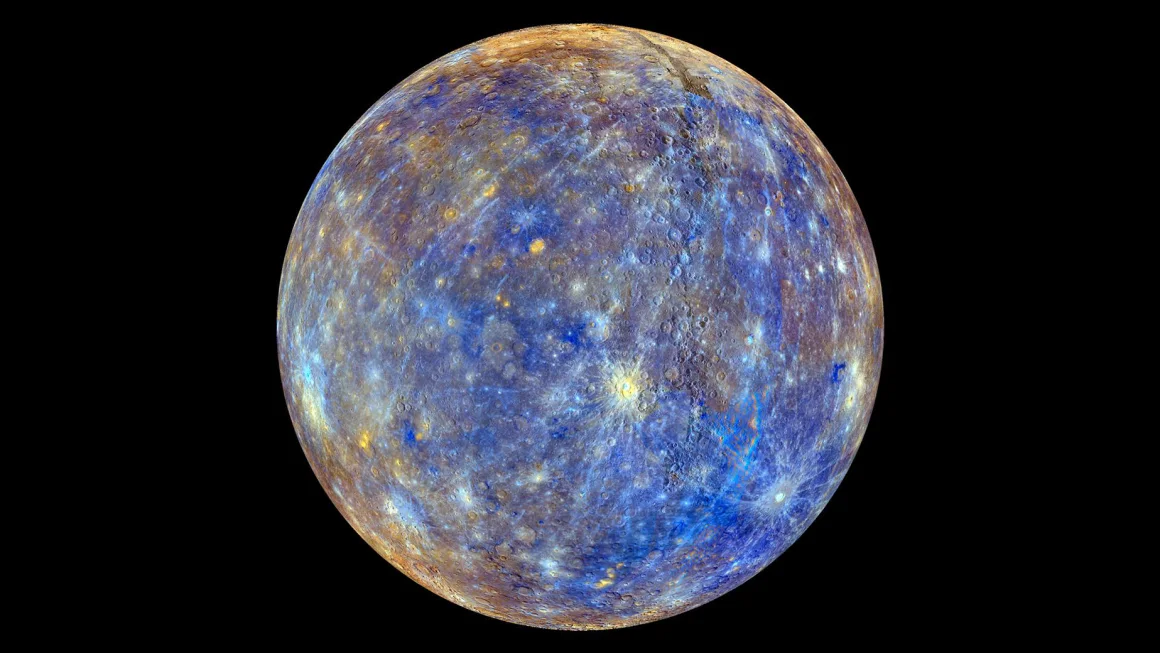
Mercury's gray surface is due to its abundant graphite content. The researchers’ experiment suggests that this graphite could have turned into diamonds due to the high pressure and temperature conditions that prevailed in the planet's early days. The presence of sulfur on Mercury, which lowers the melting point of the material, further supported the diamond formation.
Despite the intriguing possibility of a diamond layer, scientists caution that this thickness estimate is based on current models and could change as the planet continues to cool. Additionally, while diamonds on Mercury might be similar in composition to those on Earth, their size and mining potential remain speculative, given their depth of around 500 kilometers (310 miles).
Future missions, such as ESA's BepiColombo, scheduled to enter Mercury's orbit in December 2025, may provide further insights into these findings. BepiColombo, a joint mission with the Japan Aerospace Exploration Agency, is expected to enhance our understanding of Mercury's surface and internal structure.
The study represents a significant advance in our knowledge of planetary interiors, though confirmation of these predictions will rely on further exploration and analysis. As Felipe González, a theoretical physicist at UC Berkeley, pointed out, this research is an important step forward but still depends on assumptions about Mercury’s interior that future missions will need to verify.
 |
Mercury owes its gray surface to the widespread presence of graphite, which is a form of carbon. Researchers recreated the extreme high temperatures and pressure of the planet's early environment to find out whether the carbon could have transformed into diamond crystals. |





0 Comments